PopCon paper 2026
Always the Same and Never the Same: Writing About Trans Art in an Era of Trans Genocide

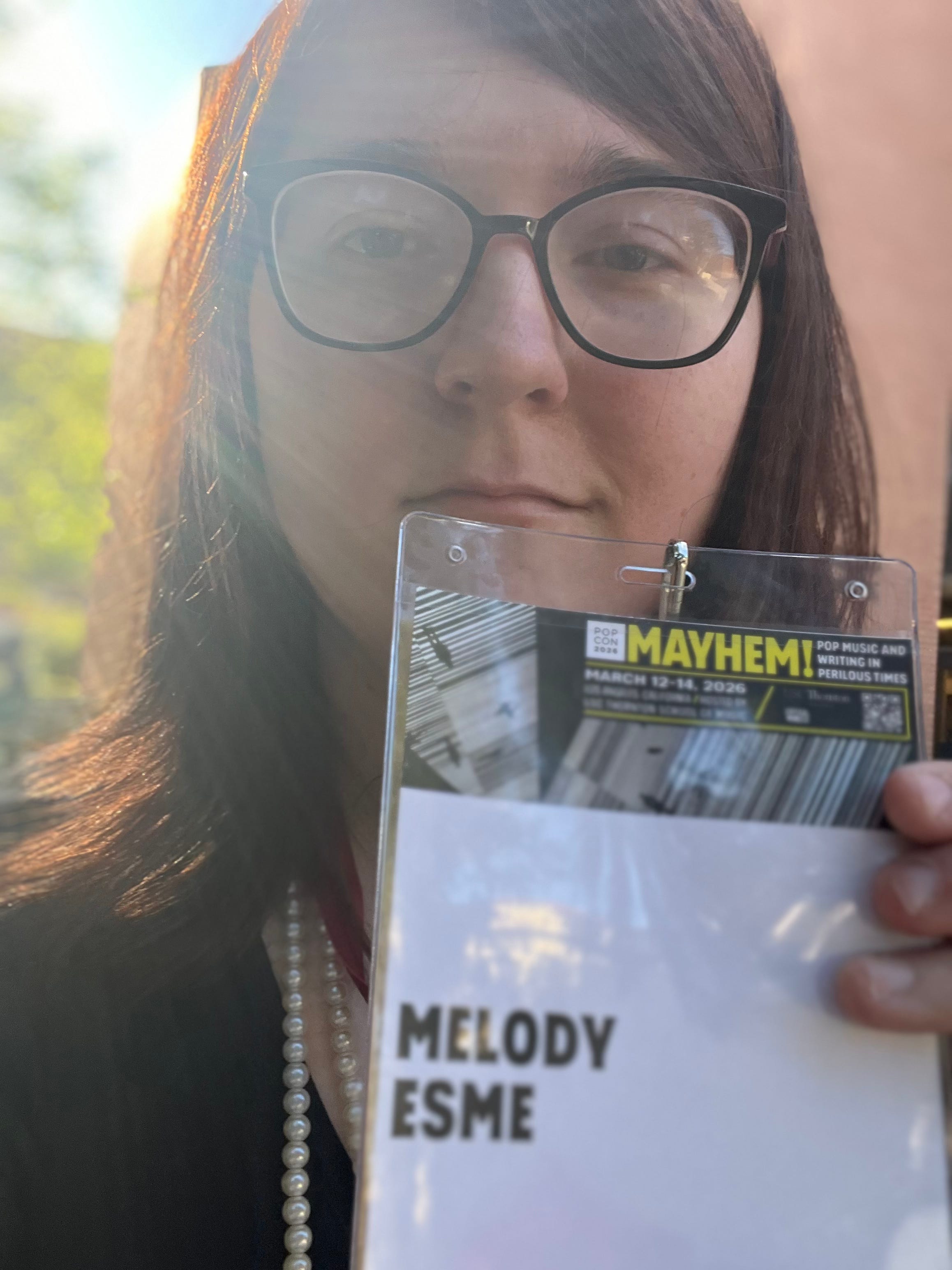
I got to achieve a dream by participating in PopCon this year, participating in a queer-focused panel along with longtime friend Alfred Soto and new friend Candace Hansen. Here’s my paper:
—
There’s a clip I can’t get out of my head. The brilliant electronic/hyperpop artist SOPHIE is on the red carpet at the 2019 Grammy’s, having received a nomination for Best Dance/Electronic Album for Oil of Every Pearl’s Un-Insides, her first studio album (the only one she would release in her tragically short lifetime). She’s being interviewed by journalist Dana Blair, when suddenly Blair misgenders her. It’s subtle but utterly corrosive, the kind of moment every trans person has experienced. You live your life constantly on guard. Then you let your guard down and are immediately stabbed in the gut. The person who did it probably doesn’t even know they did it, or if they catch themselves, they assume it isn’t a big deal. After all, it’s just pronouns, right?
SOPHIE’s entire demeanor shifts after this moment, and I imagine that it stuck in her mind for the rest of the night. Perhaps it never stopped hounding her. Imagine yourself in her shoes. It’s perhaps the biggest night of your career as an artist. You’ve received a nomination at music’s biggest night. It’s an honor you never thought yourself, as a member of a historically marginalized and underrepresented group, capable of receiving. Then, somebody thoughtlessly fills your joyous moment with bile. SOPHIE becomes visibly upset, but keeps it all inside, finishing the interview as quickly and politely as she can before moving on.
The moral of this story? Don’t be a Dana Blair.
Five months after the Grammy’s ceremony in question, I had my lightbulb moment, the most important revelation of my life. I’d long had that aching thought—“I wish I’d been born a girl”—but even after obtaining a gender studies degree and becoming very familiar with the trans community–in both theory and in my personal life–I assumed I wasn’t trans. I thought there was some sort of criteria I had to meet in order to fit the bill, unaware that wanting to be a gender other than the one you were assigned at birth is all that being trans really is, at its core. I recall once thinking, ‘Trans people only make up 1% of the population. There’s no way I’m that lucky.’ But as soon as I figured it out, I jumped in head first, never looking back, feeling that I’d wasted enough of the little time I have on this planet pretending to be something I wasn’t.
It was Trump’s first term. I’ve heard people say that trans folks who started transitioning during the Trump era are braver than the troops. Maybe so. It didn’t feel especially brave, though. The scene in Jane Schoenbrun’s I Saw the TV Glow where the suffocating feeling of unearthed dysphoria is finally acknowledged couldn’t be more accurate for me. I was chained underwater; I found a key to unlock those chains and swam up for air without thinking about it. It was instinctual.
I survived the first Trump era. Now we’re in the second, and things have gotten worse than I could have ever imagined. Trans people have been the right’s scapegoat flavor of choice for years and years now. The federal government’s rules now insist that birth sex is true sex; they’re sending trans women to federal men’s prisons, trans men to women’s, and mailing out passports whose gender markings differ from people’s driver’s licenses, birth certificates, and social security cards, causing confusion more than anything–though the desired outcome for the alt-reich is forced outing. They can always tell, didn’t you know? But still, they need to apply trickster methods, just in case.
Casey Plett wrote last year, “The truth about trans politics today isn’t that we have found our situation worse; the truth is we have found ourselves more visible. And visibility is a very, very double-edged sword. The trans struggle used to rest on our invisibility, our erasure from society. Trans sociologist Viviane Namaste’s landmark 2000 book was even called ‘Invisible Lives.’ We had a theory that if we could just make ourselves seen, then the world would love us and give us rights. That theory wasn’t all wrong, but it wasn’t all right either. Some of the world saw our struggles, and all our beauty and pain and laughter and wit and artistry and anger and hurt and endless cascades of love — and they decided to hate us more.” She continues, “sometimes visibility’s potential runs out,” before concluding that “we, and anyone who cares about a trans person, will be charged with figuring out what’s next. It won’t be fair, and it won’t be right. It will be reality.”
If you’re a journalist and you care about trans people, this is your fight. It has to be, because even more than with other marginalized groups, trans people’s oppression is verbal. It’s the words used and unused. It’s pronouns; correct and incorrect names; it’s the identifiers on our documents. It’s philosophical, theological. “What is a woman?” they ask. “How many genders are there?” they inquire. They rely on the simplicity societally attached to these questions to make us seem stupid or unhinged or even dishonest. They have the power to stomp us out, the same way the Nazis did when they burned the Institut für Sexualwissenschaft, erasing evidence of our existence; all the research that showed us as worthy of acknowledgement. They burn our history, then use the lack of existing history to pretend we popped up out of nowhere. They don’t want us to exist, and if they have their way, we won’t exist, out trans people pushed out of view and closeted trans people forcefully kept in the closet. When the second Trump era started, a graph showed that the number of 18-to-22 year olds identifying as trans had rapidly declined; somebody retweeted that graph, commenting “It was never real”—as cruel and dishonest as a Gestapo officer claiming that trans people don’t exist after setting the records ablaze.
Only, it wasn’t just anybody who reposted that graph. It was Róisín Murphy, the critically acclaimed indie electro pop artist, who lately has been more notable for her anti-trans stance than her music. This is how I clumsily transition back into talking about music.
If you’re a music reviewer in 2026, it’s unlikely that you won’t write about trans people ever, unless you make a serious effort to avoid trans people at all costs. From a pop star like Kim Petras, a hip-hop artist like Backxwash, a metal musician like Liturgy’s Haela Hunt-Hendrix, basically the entire genre of hyperpop/bubblegum bass, indie or punk artists like glass beach and, um, Melody Esme (listen to Oh Great, Hassle! by Shaking Hell whenever I end up releasing it this year, pls). Even country isn’t safe from the trans agenda, with singer-songwriters Adeem the Artist and River Shook exploring their particular varieties of queerness through traditional country music. Point being, music made by gender-nonconforming people is more prominent, prevalent, and diverse than ever before. And, unfortunately for anyone in the music space who’d rather forget we exist, trans people are, historically, really fucking good at making art. So, I guess you have to write about us, and if you’re gonna write about us, do it right.
The way trans people have been perceived and written about in the U.S. has gone through many changes. In 1952, The New York Daily News ran a headline: “Ex-GI Becomes Blonde Beauty: Bronx Youth Is a Happy Woman After Medication, 6 Operations.” Back then, trans people were viewed with a sort of awe—the ability to change your sex was seen as a miracle of modern medicine, with many wondering if Christine Jorgensen was now able to produce eggs and bear children. Decades after Jorgensen unveiled herself to the world, in 1978 and 1979, Playboy ran a series of coming-out interviews with electronic music innovator Wendy Carlos that, despite deadnaming her in the headline—a habit that seemed necessary to cis writers for too long—is rather respectful and well-done for its time.
But as history shows, a single outlier is a fascinating anomaly, while a million outliers represents a stain on the fabric of society that needs to be wiped off. The problem isn’t the existence of trans people, but the fact that we aren’t an abnormality. There are a lot of us, and the existence of trans children especially poses a threat to the norm, because if trans children exist, then that positions gender diversity a little closer to being an undeniable piece of humanity’s complexity—something that was known to, and celebrated by, many societies before European standards were forced upon the world through genocidal, colonialist stronghand. As a result, publications that may have reported about trans people with a sense of wonder 70 years ago instead report about us with a devil’s advocate, just-asking-questions attitude, and that’s when they aren’t being outwardly hateful.
In 2006, Lana Wachowski was non-consensually outed by transmasculine pornstar and all-around cretin Buck Angel (whose motivations, we can safely say, had something to do with his ex-wife leaving him for Lana). Rolling Stone ran an article with the headline: “The Mystery of [deadname] Wachowski,” which features doozies like, “And some experts believe that men who want to be women also tend to be what [deadname] Wachowski appears to be: a guy with a jones for technology.” The article has been scrubbed from Rolling Stone’s archives, for obvious reasons.
Then, in 2024, I tried to explain to an older rock critic that he shouldn’t deadname or misgender trans people in his reviews, or write that Laura Jane Grace “still sounds male.” He, maturely, reposted the entire thread on his blog and referred to me as, “Melody Esme, a former rock critic (under a different name) I respected enough to accept a Facebook friend request [from].”
As with any marginalized group, the rights and accommodations we are seeking are perceived as special privileges we’re demanding. But these accommodations are simply equitable corrections, making up for rights that cis people take for granted—the right to exist comfortably in your own body, to have hormones in your body that don’t slice you like barbed wire, and to be called by names and pronouns that reflect who you really are. Like Laura Jane Grace sang, “What God doesn’t give to you you’ve got to go and get for yourself” (in a song released two full years before she publicly came out, funnily enough). Unfortunately, even the most radical, progressive cis allies have experienced growing pains over the years, as the trans community has moved to the foreground—no longer a fringe group on the outskirts, but your kin, your friends, your neighbors, people you’re likely to see out in the world regularly.
Some may say I can’t keep up with the rules. So, because I’m a list autist, I made a numbered list, Here are the rules if you wanna write about trans art.
Rule #1: don’t deadname. Just don’t do it. A trans artist’s name isn’t a nom-de-plume, it’s their name, and our birth names are often painful to hear or read. Grace has publicly stated that she wishes she could wipe her deadname from the Internet. In the case of an already-famous artist coming out, context clues are fine. “Juno actor Elliot Page comes out as a trans man” speaks for itself, while in the case of a more niche celebrity, “Against Me! lead singer comes out as trans” would confuse just as many people as deadnaming Grace would.
Rule #2: don’t misgender. Duh. Where I can understand the logic behind deadnaming—as background information or added context or whatever—misgendering on purpose is bigotry, plain and simple. So make sure you know an artist’s pronouns, and if you get them wrong, throw out a “my bad” and correct yourself. And please never complain about how hard it is to understand pronouns. It’s okay to make mistakes; don’t be annoying about it.
Rule #3: avoid microaggressions and just plain aggressions. To use a previous example, saying that Laura Jane Grace “still sounds male” is the type of shit that will turn even the best review you’ve ever received into the absolute worst. Meanwhile, backhanded compliments, like “she sounds surprisingly female” or “she looks like an actual woman”—evil, knock it off.
Rule #4: center trans people in our own narratives. There’s one example of how to do this incorrectly that has stuck in my mind for years. The YouTube video essayist Polyphonic made a video titled “A Brief History of Trans People in Music.” And despite my enjoying plenty of Polyphonic’s work, that video is a mess. It never mentions Wendy Carlos, Anohni only gets a passing mention, there’s no mention of Jayne County or Genesis P-orridge or even SOPHIE, despite the video being released in 2019. Instead, most of the short runtime is spent talking about songs about gender fuckery by cis-presenting artists, and the muses of David Bowie and Lou Reed. All in all, trans musicians are discussed for roughly 2 minutes, 49 seconds, and non trans musicians 3 minutes, 48 seconds.
I fully understand the role that gender-bending rock stars have had in aligning rock and roll with transgender iconography—plus, I think that the temptation of twinky male rock stars to put on makeup and dresses and hang out with trans women could certainly have been their way of dipping their toes in. Ask me about Kurt Cobain; I’ll talk for an hour. But trans people are more than the muses of the David Bowies and Lou Reeds of the world, and we deserve to be at the table. Especially if the table in question is, y’know, our fucking table.
Rule #5: gender essentialism is for babies. Remember when SOPHIE’s early singles and production credits prompted people to say things like, “this man is pretending to be a woman and taking attention away from ‘real’ female producers?” Grimes was the most high-profile person to say this, but she wasn’t alone, and this seemed to pressure SOPHIE into coming out. Look, I get it: I am a trans lesbian who was forced to exist in male spaces for most of my life, so I certainly dabble in misandry myself. But gender essentialism, at best, reinforces society’s gender norms and, at worst, discourages people from dipping their toes in and discovering what gender works for them. Phrases like “music for boys,” “appropriating femininity,” or even a potentially very useful one like “queer-baiting” can, in most all cases, be excised.
Rule #6: put effort into understanding our perspectives. I’ve seen cis people say they didn’t understand how I Saw the TV Glow was a trans story (wild, considering my 70-year-old Reaganite mother understood what the film was about). I talked to the film critic Sally Jane Black about this, and she compared it to saying “Do the Right Thing is about pizza.” Not being trans doesn’t mean you can’t do your best to get what our stories are saying and analyze it. Empathy might be the most underrated quality a critic can have.
Rule #7: hire more trans writers. Contrary to what I said in rule #6, being able to understand the trans perspective isn’t a substitute for platforming that perspective. So hire us. If you can’t find trans writers, start here. Please give me work. I’m very broke.
And finally, rule #8: use your platform to advocate for us. If you care about us, then you need to declare it. Scream it, publicly, whether in print or aloud. Show that we matter, that we aren’t on our own. Genocide happens not with a bang but with a whimper, something easy to miss if you don’t care to look. Federally, we can no longer change our documents. Kansas has started revoking trans people’s drivers licenses. While I was finalizing this paper, more news kept popping up. The 4th Circuit court ruled that states can compel trans adults to “appreciate their sex” via healthcare bans, and Florida passed a bill letting Ron DeSantis remove elected officials from office for “promoting pride.”
There’s even a handy map passed around our community, showing which states it’s safe to live in, and which ones it’s not even safe to travel through. The state we’re in now [California] is one of the safest for us. And its governor still bonded with Charlie Kirk, when his neck was still intact, over their shared opinions on trans women in sports. Point is, things are bad. If you care, speak up. Write about us, celebrate us, and do it right.
Ultimately, I’m not going anywhere, and once again, it’s not because I’m brave—truth be told, I’m terrified, all the time. But I can’t live any other way ever again. Death before detransition, always. Please do what you can to ensure that’s not a decision any trans person has to make. Let your words show that the world cares. The biggest threat to a fascist is the truth that the populace has more of a soul than they give it credit for—and the second biggest threat is a guillotine, but we can talk about that another time.